
Are tactical puzzles overrated?
Or: should we only train shooting the ball at the goal?

Hi!
If you are a beginner or a club player (let’s say up to 2000 FIDE or 2250 rapid lichess) and you ask for advice on how to improve your play, you are most often going to get advice: “train chess tactics!”. This advice in itself is probably reasonable but sometimes people go even more extreme and say “train ONLY chess tactics, anything else at that level is a waste of time”. And with that last advice I can’t agree. Maybe I could agree with that if you were an absolute beginner and you were giving away your queens and rooks every game, but if you are in the club player rating range (1600-2000 FIDE), not necessarily…
Well, I don’t want to say that tactics are not important. They are. Maybe they are the most important chess skill even. But even if they are, can you imagine someone recommending that a football player (US translation: a soccer player :-)) should only train shooting at goal? Even if scoring goals is the main purpose (or, well, the goal of the game :)), it is hard to become good at football if you don’t have endurance for 90 minutes of play, you don’t know how to position yourself on the football pitch, you don’t know how to pass balls, dribble, play the ball with your head etc.
Or can you imagine someone recommending that to learn a new language, you should only learn nouns? If you had to choose only one part of speech, probably nouns would be a better choice than verbs or adjectives, but it would be hardly a good advice “learn ONLY the nouns, anything else is a waste of time”. Usually you start with learning a fair mix of different parts of speech, and how to build sentences with them, etc. Why should chess be different and why should your success rely only on tactics?
In June 2023 I had some very embarrassing tactical mistakes in my tournament games and I asked my chess coach what to do. He recommended me to to solve tactical puzzles from a good book. I eagerly started doing it. I continued doing it between July 2023 and February 2024 for at least 15 hours a month, sometimes more than 20 hours. Even though chess is my main hobby, so many hours a month is a major commitment.
But I didn’t feel that it was helping my chess. I was feeling I was still making dumb mistakes. Not dumb as in “hang your queen to be grabbed immediately” but dumb like this:
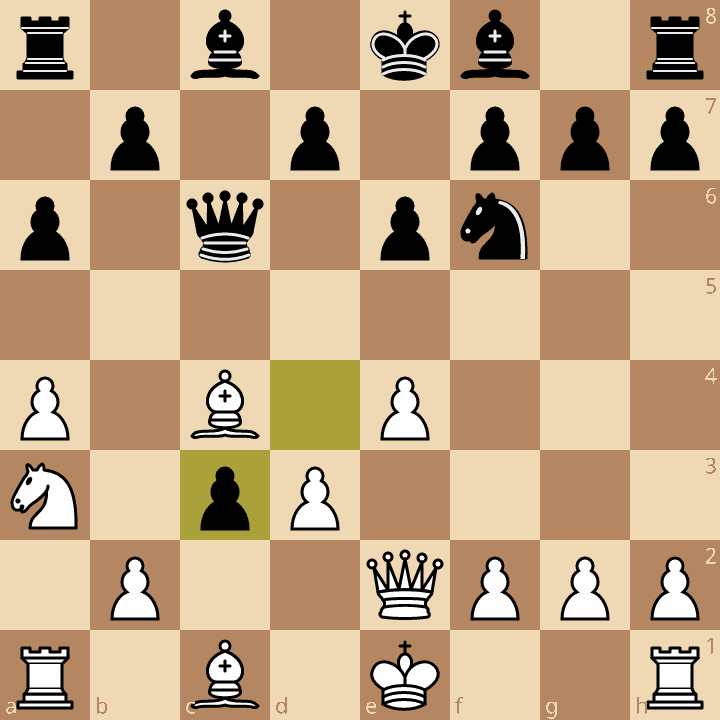
O-O is best here but there are several other moves which keep the position of White relatively intact. But I played automatically bxc3. I just didn’t feel that the position called for switching on the calculation mode! Not at every move you need to calculate but sometimes you really do! I have strong bias towards abstract positional play, often neglecting concrete considerations and it happened precisely then.
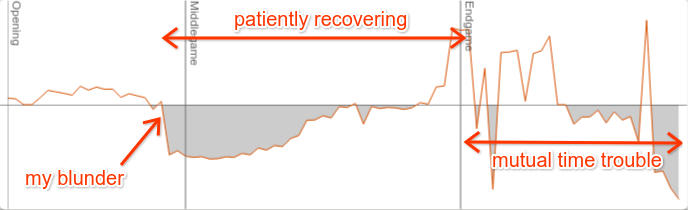
b5 followed from my opponent and I was losing a piece. I could have only chosen if I preferred to lose my bishop or my rook. (Bizarrely, owing to working very hard on this game and slowly improving my position, I managed to equalise about 20 moves later and even got a winning position which I finally wasted due to being in time trouble.) The following lichess move by move evaluation graph shows the progress of that game:
The Chess Angle podcast (thechessangle.com, highly recommended!) divides chess skills into three dimensions: tactics, strategy or positional play, and chess psychology.
If I am not able to see a tactical pattern, it is my tactics to be blamed. If I can see the pattern but cannot calculate the outcome correctly, it is calculation to be blamed (which mostly fits into the tactics dimension). And both can be addressed by solving more chess puzzles. But if someone showed me the position from the game after my bxc3 move and asked “find the best move for Black”, I would have easily solved such a tactic! I am capable of solving much more difficult tactical positions. Above, I simply didn’t perform the right thought process, which I was capable of doing! So this blunder falls rather into the chess psychology dimension than in tactics. Later I equalised due to stubborn strategical play (so: strategy). And finally I lost the endgame after making more blunders which were so trivial that they can only be explained by being in an extreme time trouble. Time management is, again, chess psychology.
Now, could solving more chess puzzles be a solution to problems like above?
No, because chess puzzles usually train you how to notice a clearly winning move when there is a (usually only one) clearly winning move. (Note: chesstempo.com has a nice selection of defensive puzzles.)
No, because chess puzzles usually don’t train you how to choose from several reasonable moves rather than playing a disastrous one.
No, because when solving chess puzzles you usually have your “calculation mode” on, while during a real game often you have it off.
So, I had this intuitive feeling that doing more and more chess puzzles didn’t help me avoid situations like above. But while I usually trust my intuition, I prefer to back it with sheer numbers :-).
So I sat down, analysed 80 of my OTB games (half of them before I started my intensive tactical training and half after starting it) and compiled the following table:
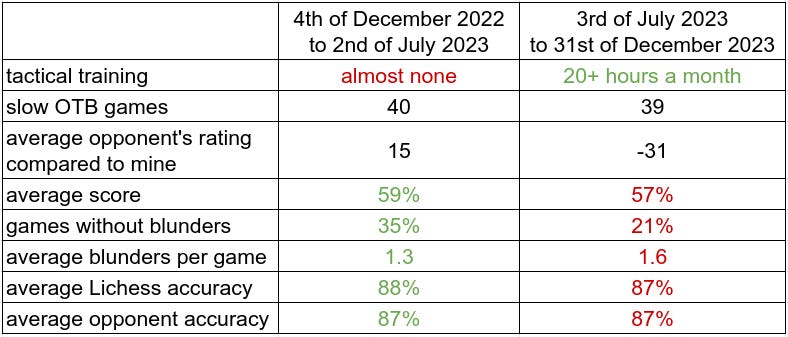
So what we can see here? Despite doing 20 or more hours of tactical training per month for several months and playing somewhat weaker opponents in the latter period:
I got slightly worse average score. Given weaker opponents, the score should have been higher even with same training.
Got lower percentage of games without blunders. Tactical training was supposed to let me reduce the number of blunders, right?…
Got higher average number of blunders per game than before.
Accuracy of my moves in my OTB games according to lichess analysis became slightly lower. It is only 1% but it shouldn’t be lower at all against lower rated opponents!
The accuracy of my opponents remained the same. This actually makes sense - my opponents shouldn’t make more mistakes just because I started tactical training. This also shows that my games didn’t become sharper in general.
So I compiled this table and asked my chess coach (another than the one who prescribed me the chess puzzle book) what to think about it and what to do with this? He said “you shouldn’t give up tactical training just after 6 months. It works for everybody, so why shouldn’t it work for you?”… I am not a fan of giving up and changing things very often, as you usually need to put in some consistent effort to see the results, but if something clearly doesn’t work after 6 months, how much should I wait?
We can see that I played considerably worse in the period of training tactics intensively. But of course, I agree that training tactics shouldn’t be detrimental on its own. So I started asking myself: “if I wasn’t training tactics in the first half of 2023, what was I spending my time on?”. And the answer was that in the first half of 2023, I played at average 40 rapid 15+10 games per month (and always analysed them after playing) while in the second half of the year I reduced it to only about 10 rapid games per month. Actually I started reducing the amount of my rapid games already in May 2023, and then I started seeing increase in the number of blunders in my OTB games in late June 2023.
So I started pondering: maybe playing (and analysing!) 40 rapid games per month is more effective than solving 20 hours of puzzles? But my coach didn’t address the numbers that I observed, and simply believed that it was only doing the puzzles that mattered…
Then in mid February 2024 I had my worst chess day ever ;-) during a tournament. In the morning I barely escaped with a draw against a 200 points lower rated opponent and in the afternoon I was completely destroyed after 15 moves by a 460 points lower rated player. I came to conclusion that doing mostly tactical training was probably not the right solution, at least not for me, and decided to change my training plan completely. I will write about it in the next post :)!